Little, Big, or The Fairies’ Parliament by John Crowley.
Got this about 1980, read it, and was blown away. The interweaving of children’s books, Celtic Twilight, family history, social upheaval, theosophy, and fairy lore is such a complex and mesmerizing knot and carried out by such solid characters that it is hard to fully describe the impact. Each new source and reference I recognized only made me fonder and fonder of the book. It seemed to have been expressly written for my reading habits, from grade school on up. Although I’ve read many if not all of his works since then, nothing before and nothing since then has equaled it. This is my original copy and has my initials on the copyright page. Spine a little cracked from so much use but binding still tight.
Ranking: Essentially Essential.
File Code: Fantasy. Novel. Paperback.
Beasts, by John Crowley.
Re-issued in the wake of the success of “Little, Big”, “Beasts” is Crowley’s first novel, and this edition shares a cover-style and artist with that book. In the near future, the country has been torn apart by civil war. In the chaos, a group of man/lion hybrids, created by science, seek to live on their own, free of the conventions of men that would entrap them. Entertaining, poetic, and a rumination on Nature and Man’s separation from it.
Ranking: Keeper.
File Code: Science Fiction. Novel. Paperback.
The Deep, by John Crowley.
Re-issued in the wake of the success of “Little, Big”, this edition shares a cover-style and artist with that book. Into a flat world upheld by a creature called Leviathan falls a strange traveler. The fall damages his memory, and he must wander a land riven with power struggles between the Red and White factions to try to rediscover his purpose. The world-building of this … fantasy? … ultimately science fiction? … carries it along with its nomenclature, lore, and War-of-the-Roses-like conflict. Kind of reminds me of “The Man Who Fell to Earth” and I picture the androgynous Traveler as David Bowie.
Ranking: Keeper.
File Code: Fantasy. Novel. Paperback.
Engine Summer, by John Crowley.
Ah, now this, this book is a wonder, and a worthy precursor to “Little, Big” (again, in a similar cover style). Set in a post-collapse future, when most people have forgotten the past but still use puzzling fragments of old culture, the young man named Rush seeks for the answers to old stories and in the process makes a story for himself, which he then becomes. It shows a slower, gentler world, and examines the way different groups have adapted to the leftovers as the world slowly heals itself. “Always Coming Home” reminded me of this book when it came out. A poetic work, evoking the feelings of the season its title invokes.
Raking: Essential.
File Code: Novel. Science Fiction. Paperback.
I, Claudius, by Robert Graves.
After having seen the mini-series on PBS and borrowing Mrs. Hardcastle’s copy for a while, I got my own books (including “Claudius the God”) at Hastings. This was my junior year. Thus started my rambles with Robert Graves. Claudius was just the sort of hero I identified with, a clever man, but something of a dunce at living, and misunderstood by all but his closest friends (and not always by them). In the cold-blooded, ambitious figure of Livia I saw a prophetic portrait of Nanny. Often pronounced “Clavdivs” as a joke in our family and a little overshadowed by the television production. I remember trying to pass it off as “historical reading” in my freshman year of college.
Ranking: Essential.
File Code: Novel. Historical. Paperback.
Claudius the God, by Robert Graves.
Graves admitted that he intended to stop the story with Claudius becoming Emperor, and then when his publishers clamored for more, he had to produce another unexpected book. He plumped it up with the history and character of Herod and with the infidelities and sexual exploits of Messalina. In the end, for all his good intentions, Claudius cannot fight fate: he is poisoned by Agrippina and succeeded by Nero. Not quite as convoluted or detailed as the first book (since it mostly deals with Claudius’ reign and not the Caesar family history).
Ranking: Essential.
File Code: Novel. Historical. Paperback.
Howl’s Moving Castle, by Diana Wynne Jones.
“I have been aware of Diana Wynne Jones since at least 1982, when I bought and read A Reader's Guide to Fantasy from cover to cover in search of new wonders. The short summations supplied there did nothing to tempt me, and the bouquet of her Nomenclature (I tend to judge an author to some extent on the surety of their Naming of characters, places, and things) seemed very plain. I have since come to find this style of Nomenclature in the hands of a fine author like Diana Wynne Jones is a delicate, simple, and transparent method that does not get in the way of the storytelling. There was always plenty of Ms. Jones to be had. Every time I would search the shelves, I would pass a huge wodge of books I would automatically jump over, cursing her (unfairly) for taking up space while the books I wanted were elsewhere. There are as of today (depending on how you count them) about fifty volumes to her credit. Of course, the comic, karmic flipside for me is that now that I want them, they are locally rather thin on the ground. At the time, as I said, they were merely unwanted filler. Hayao Miyazaki's animated adaptation of Jones' book Howl's Moving Castle came out ... I love Miyazaki's work, and this was one of his best. If she could inspire this, I thought, maybe there's something to her stuff after all. Still, by the time I saw the film out on DVD, a copy of the book was hard to come by, so I temporized. Then I got a copy of Jones' A Tough Guide to Fantasyland. I had heard good things about it, and it turned out to be as advertised: a hilariously funny parodic encyclopedia of the clichés of Fantasy writing. I laughed and groaned as I recognized my own past sins time and time again, from the perils of STEW to the plain facts about BOOTS and HORSES. Still, it was not a sample to judge her storytelling chops from. When I finally did get a copy of Howl's Moving Castle and sat down to read it, I found it was not a fair experience. I went in looking for the movie, and it made the book hard to see. The movie had, of course, simplified the plot somewhat and the characters a lot; the book had more leisure (not fat) with its story, the movie had changed, merged, and excluded many characters and their fates. I came away from the encounter not totally convinced, but momentum in Jones' favor was building. It came to a head with Castle in The Air. This was a sequel to HMC, and in the same format as my copy. I decided to buy it and give it a shot. And my enthusiasm just took off. I was able to go back and read HMC again on its own merits, and this time enjoyed it immensely.” - Power of Babel, June 2010.
Ranking: Essential.
File Code: Novel. Fantasy. Paperback.
Castle in the Air, by Diana Wynne Jones.
Sequel to “Howl’s Moving Castle”, with a different character focus and an Arabian-style setting. Reminds me a little of “The Horse and His Boy” in that the heroes from the earlier book wander into the life and story of the character focus. Read in 2010, part of my DWJ mania.
Ranking: Essential.
File Code: Novel. Fantasy. Paperback.
Doctor Mirabilis, by James Blish.
The first in his “After Such Knowledge” trilogy, in which Blish examines the pursuit and cost of secular knowledge. This is a straight historical novel about Roger Bacon, a scholar only reputed to be a magician, and it is full of politics and religious thought, but no fantasy. I must admit I’ve found the reading rather dry and long and haven’t ever sat down to read the book straight through.
Ranking: Essential to the collection.
File Code: Novel. Historical. Paperback.
Black Easter, by James Blish.
This book, with its continuation, “The Day After Judgement”, is considered the second ‘volume’ of the “After Such Knowledge” trilogy. A bored industrialist hires a black magician to release a horde of demons on the world, just to see what they’ll do, while the representative of some monkish ‘white magicians’ try to hinder them. Fascinating for its portrayal of ritual magic, exactly as described in medieval grimoires, and its interaction in the modern world. The most chilling moment (for someone who has been tempted) is when Theron Ware reveals that all magic, even so-called ‘white’ magic, is evil and forbidden. For lore, fascinating characters, and high-stakes storytelling, this book really engages.
Ranking: Essential.
File Code: Fantasy. Novel. Paperback.
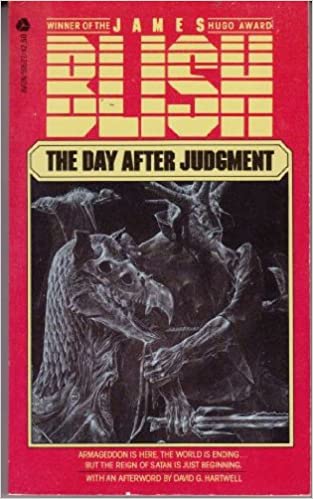
The Day After Judgement, by James Blish.
Book 2 of the second book of the “After Such Knowledge” trilogy. The Apocalypse, initiated by the release of 42 demons on Easter, has come and gone, and apparently Satan has won. Four men who witnessed that releasing ritual now travel across the world, viewing the devastation and going to confront the new Lord of the World. All the action and suspense of the first part, as Satan’s victory seems to be somehow incomplete and might be challenged, some dancing on the grave of the world, and a surprise ending that’s quite surprising. References to C. S. Lewis and Milton spice things up for the nerd in me.
Ranking: Essential.
File Code: Fantasy. Novel. Paperback.
A Case of Conscience, by James Blish.
Science fiction this time, in the third volume of the “After Such Knowledge” trilogy. When a scientific priest visits a planet where it seems the reptilian Lithians have achieved morality through entirely rational means, he suspects a Satanic trap for Mankind. Can real virtue be obtained without Divine revelation? And is the Lithian creature he escorts back to Earth a new serpent in the Garden of Eden, meant to undo the work of redemption? If rational beings can achieve virtue from Reason alone, what need have they for a Redeemer? A fascinating fable, the conclusion allows wiggle room for both faith and skepticism.
Ranking: Essential.
File Code: Science Fiction. Novel. Paperback.
Well, for a start, this shall be the home for my Biographical Inventory of Books. After that, who knows?
Thursday, July 30, 2020
Wednesday, July 29, 2020
Myths and Fantasies
Witchcraft and Black Magic: A Bantam Knowledge Through Color Book, by Peter Haining, Illustrated by Jan Parker.
First ran across this book in middle school, I think, and it creeped me out! The artwork is that 1970’s era of occult that reaches past rational thought and into my darkest childhood fears. The Witch of Berkeley, Mother Damnable, The Monk of Prague, the Chelmsford ‘thing like a black dog’, Aleister Crowley looking even scarier than he ever did in real life – powerful and sinister images that remind me of early horror shows like “The Night Gallery”. The spine and cover have some damage.
Ranking: Probably should get rid of it; even destroy it.
File Code: Reference. Magic. Paperback.
Witches, Wraiths, and Warlocks: Supernatural Tales of the American Renaissance, Edited by Ronald Curran. What it says on the label, in three parts: folk tales, the popular tradition, and the literary tradition. I think this used to belong to John, and it was bought either at Half’s or Yesterday’s Warehouse. An excellent anthology to get me into the mood to write my own book. Still in pretty good shape for being published in 1971. Ranking: Essential. File Code: Anthology. Short Stories. Paperback.
Medieval Myths, by Norma Lorre Goodrich. A Mentor book, in fair condition for being printed in 1961! Right in my wheelhouse, but I must again confess, never really read. Ranking: Dispensable, but why? File Code: Reference. Myth. Paperback.
Myths and Legends of Ancient Egypt: A Bantam Knowledge Through Color Book, by T. G. H. James, Illustrated by Brian Melling. Bought at Hardt’s in New Braunfels but known in middle school. Brightly colored so it avoids the usual drab sand-and-stone tone of most books on Egypt. The mythology is not systematic and thus is hard to pin down, but the book does a good job recounting the main beliefs, stories, and religious context. Not close to my heart, though. Ranking: Dispensable. File Code: Reference. Myth. Paperback.
Inferno, by Larry Niven and Jerry Pournelle. A science fiction writer dies and goes to Hell, which is exactly Dante’s vision, and is guided down and out by an incognito Benito Mussolini, who is doing penance for his mistakes by helping souls escape. Along the way they encounter updated punishments for updated sins, especially for those in the literary community (people tend to notice their own folks, as one character comments; that’s why Dante ran across an inordinate amount of Italians during his trip). An amusing Bangsian fantasy filled with drama and a surprise redemption at the end. Wear to cover and spine; secondhand. Ranking: Pretty damn good. File Code: Novel. Science Fiction/Fantasy. Paperback.
Neverwhere, by Neil Gaiman. Gaiman’s first solo novel, and quite a good one. Peter Mayhew is a man who finds himself drawn into a parallel London after he helps a girl in distress. I detect a whiff of Chesterton’s influence here, with the old London names (Earl’s Court, Blackfriars) having fantastic meanings on the secret side. Entertaining, but not as compelling as later work. Ranking: Keeper. File Code: Fantasy Novel. Paperback.
The Firelings, by Carol Kendall. I’ve seen it described as a prequel to the Minnipin books, but you could hardly tell it, and it was written last in the series. Series killer! It takes place on a volcanic island, and if the halfling-like people there are the ancestors of the Minnipins, they sure don’t act like it. An unsatisfying continuation to two great books. Ranking: Keeper. File Code: Children’s Book. Paperback.
Flying Sorcerers: More Comic Tales of Fantasy, edited by Peter Haining. The only reason I have this is for the short story by Terry Pratchett (“The Turntables of the Night”) and the cover by Josh Kirby. There are a few other good tales, but most I have elsewhere. Peter Haining strikes again! Ranking: Keeper, for the Pratchett collection. File Code: Fantasy. Anthology. Short Stories. Paperback.
Tuesday, July 28, 2020
Some of the Best Penguins and Pelicans
The Canterbury Tales, by Geoffrey Chaucer, Translated into Modern English by Neville Coghill.
A Penguin Classic. I have read some of these tales but not all of them. An interesting feature of this book is that Neville Coghill was a member of the Inklings. Every English student needs a copy. Has my name in it.
Ranking: Keeper.
File Code: Classic. Paperback.
Fables of Aesop, Translated by S. A. Handford. A complete edition of the most original and authentic fables. Penguin Classic, with illustrations. Ranking: Keeper File Code: Fables. Classic. Paperback.
The Mabinogion, Translated by Jeffrey Gantz. The Welsh collection of myths and legends par excellence that so many fantasists have based their books on. I must confess to not reading it thoroughly, but must have it for … scholarship, I guess? Penguin Classic. Ranking: Keeper. File Code: Classic. Paperback.
Njal’s Saga, Translated by Herman Palsson Now this book is the real deal, a Norse saga of incredible detail and stark storytelling, that tells of a feud with as many twists and turns as any soap-opera. A look at Icelandic life (which is as much about law-courts as it is about ‘Vikings’ and violence), with a smattering of mysticism and fate to keep it spicy. Parodied by Monty Python (probably mostly by Terry Jones, who was a scholar in that area) as the ‘terribly violent’ “Njorl’s Saga”. Got this copy of the Penguin book at the college bookstore. Ranking: Essential. File Code: Saga. Classic. Paperback.
The History of the Kings of Britain, by Geoffrey of Monmouth, Translated by Lewis Thorpe. Legendary history of Britain, famous for its early depiction of King Arthur. And when I say legendary history, I mean that both legends and history are mixed together like sugar and sand here. There is much more than just Arthur, but the popularity of that section led to Geoffrey’s ‘sequel’, “The Life of Merlin”. Penguin book, college years, Arthurian craze. Ranking: Essential for reference. File Code: Classic. Paperback.
The Twelve Caesars, by Gaius Suetonius Tranquillus, Translated by Robert Graves A gossipy, scandalous, racy history of the first twelve ‘Caesars’ to rule Rome (the first six were from the actual family, the next six assumed the name as a title). Interesting not only because of its historical ‘tell all’ nature, but because it is translated by Robert Graves, of “I, Claudius” fame, and in his prose style. Fun! Another Penguin. Ranking: Essential. File Code: Classic. Paperback.
Life in Shakespeare’s England, Compiled by John Dover Wilson. Aspects of Elizabethan and Jacobean England, as described by contemporary writers. A wonderful browser, with accounts of the culture by people who experienced it. The cover shows pretty bad wear; bought it second-hand and wouldn’t mind upgrading if I could find a better copy. Penguin. Ranking: Essential Reference. File Code: Classic. Book of Excerpts. Paperback.
Gothic Tales of Terror, Volumes One and Two, Edited by Peter Haining. Anthology of longish short stories put together for Penguin Books by Haining, connoisseur of horror and mystery. Some good, some bad; most of the good ones I have elsewhere. However, who knows what might interest me in the future – and if I sell them, how much could I actually hope for? Ranking: Dispensable, but why? File Code: Anthology. Horror. Paperback.
Gods and Myths of Northern Europe, by H. R. Ellis Davidson What is says on the label, it is not a retelling but an organization and examination. I’ve had occasion several times to use this volume to write school papers for others, and it is an unfailing resource. A secondhand book, full of under-linings and a few notes, but dead useful withal. Ranking: Essential File Code: Mythology. Norse. Reference. Paperback.
The Greek Myths: Volumes I and II, by Robert Graves. Short retellings of the Greek myths, followed by notes by Graves, often about his dubious ‘anagogic’ readings of them through the spectacles of his White Goddess and mushroom cult spectacles. As scholarship, rather suspect; as collecting and retelling the myths, a brisk and thorough exercise. Ranking: Half of it’s Essential. File Code: Mythology. Greek. Reference. Paperback.
Subscribe to:
Posts (Atom)


